Company Agent (ConnectWise)
Last updated: May 21, 2026
Updated May 21, 2026
Overview
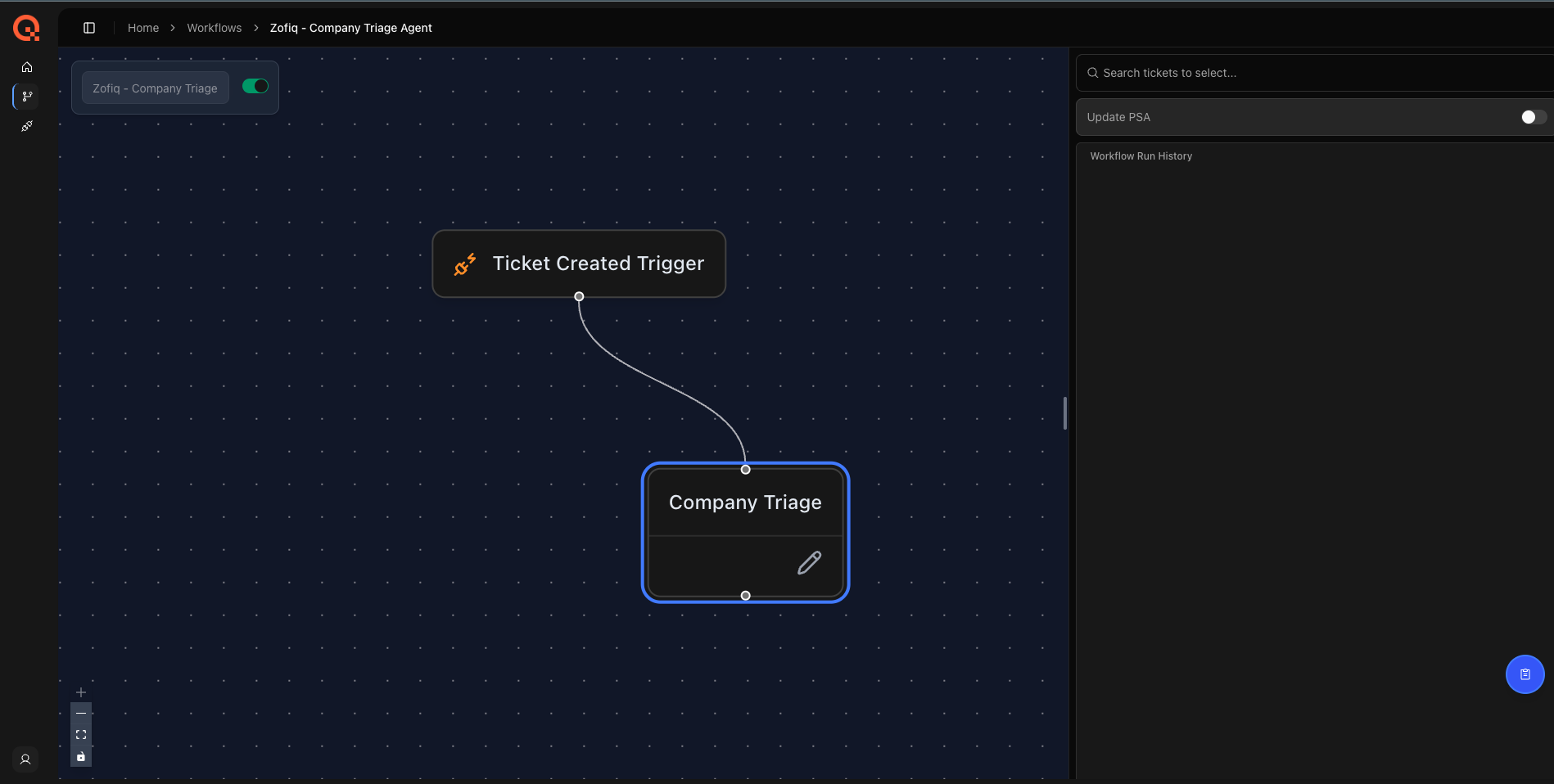
The Company Agent ensures that every ticket in ConnectWise is associated with the correct company.
Its primary purpose is to automatically set or correct the Company field when it is missing or assigned incorrectly. This prevents tickets from being worked under the wrong customer account and reduces manual cleanup during early triage.
The Company Agent is a foundational triage agent. Many downstream agents rely on accurate company context to make correct decisions. Because of this, it is designed to run early in the workflow before contact, agreement, or dispatch logic is applied.
Warning: If you have a downstream workflow that sends personal information to a company based on the company assignment, we recommend changing your messaging so it does not expose customer information, or turning off this agent. While the Company Agent can be 99.9% accurate, if it makes an incorrect assignment, it could expose the ticket to the wrong customer.
Important Execution Behavior
The Company Agent runs once per ticket.
After the agent evaluates a ticket and completes its action, it will not run again on that ticket, even if:
The ticket changes status later
The ticket is moved back to the same board
The Company field is manually edited after the agent runs
If a company needs to be corrected again, it must be done manually.
When This Agent Runs
The Company Agent evaluates a ticket when all of the following conditions are met:
The ticket enters a configured board
The ticket reaches a configured status
The ticket’s current Company value matches one of the configured Company trigger filters
Any applicable Standard Operating Procedures (SOPs) allow the evaluation to proceed
All four conditions must be satisfied for the agent to activate.
This ensures the agent runs at the correct point in the workflow, only for tickets with untrusted company values, and only when no SOP rule restricts or overrides the agent’s behavior.
Example
You may configure the agent with the following conditions:
Board equals Catchall
Status equals New
Company Filter includes Catchall
In this configuration, the Company Agent runs when a ticket reaches the New status on the Catchall board and the current Company value is Catchall, unless an SOP rule prevents reassignment.
This allows you to safely automate company correction while preserving explicit operational rules.
What This Agent Can Change
The Company Agent can update only one field:
Company
The agent does not modify any other ticket fields by itself.
If the agent cannot confidently determine a better company assignment, it will leave the existing company unchanged and record the decision in the workflow logs.
Important Note: ConnectWise Company Switch Behavior
Company Changes Reset the Contact Field
In ConnectWise, changing the Company field automatically resets the Contact field.
If a ticket originally has a contact assigned and the Company Agent updates the company, the contact will be reset to the default point of contact for the newly assigned company. This is standard ConnectWise behavior and not specific to zofiQ.
Because of this behavior, the Company Agent is intentionally positioned before the Contact Agent in the zofiQ orchestration flow.
Configuration Options
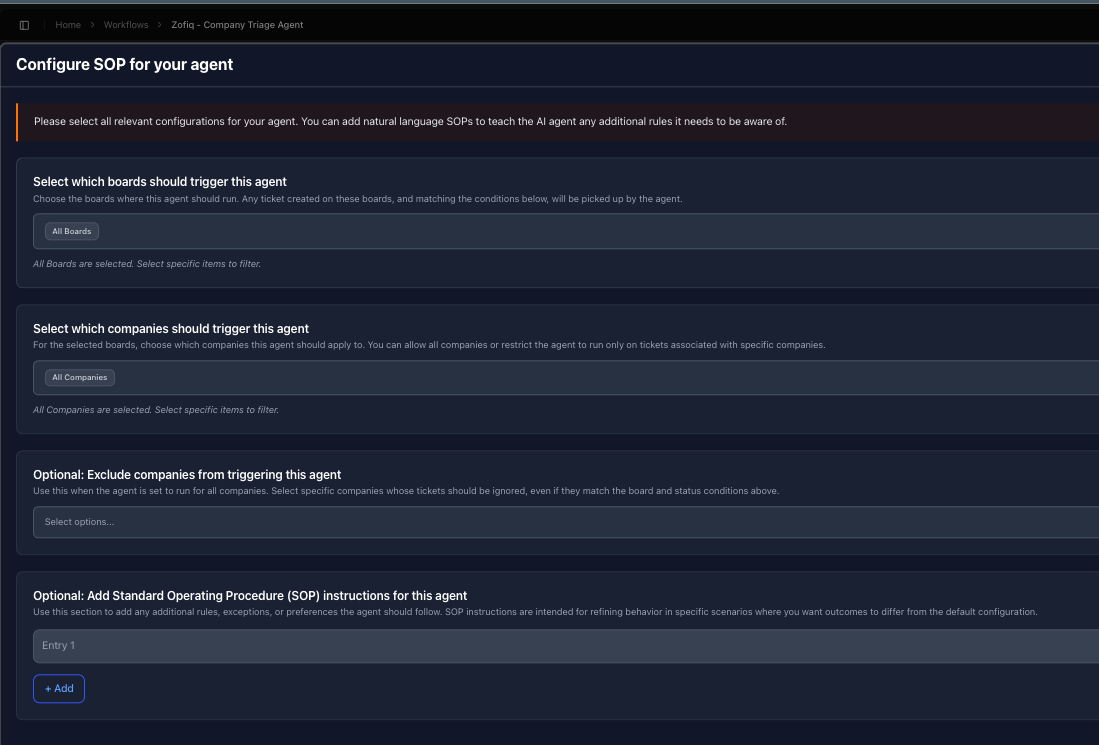
Company Configurations
The Company Agent uses a combination of board scope, company scope, exclusions, and optional SOP instructions to determine when the agent should evaluate a ticket and whether it is allowed to make changes.
1. Select Which Boards Should Trigger This Agent
This setting defines where the agent is allowed to run.
Select one or more boards where the Company Agent should evaluate tickets. Only tickets that exist on these boards will be considered.
If all boards are selected, the agent may run on tickets from any board, provided all other trigger conditions are met. The agent is set to run on all boards by default.
This setting does not determine what the agent changes. It only controls eligibility based on board placement.
2. Select Which Companies Should Trigger This Agent
This setting defines which existing company values are eligible for evaluation.
The Company Agent will only evaluate tickets whose current Company field matches one of the selected companies.
This is commonly used when:
Tickets are created under a placeholder company such as Catchall or Unknown
Certain company values are known to be unreliable at ticket creation
If all companies are selected, the agent may evaluate tickets regardless of their current company value, unless restricted by exclusions or SOPs.
Important clarification:
This setting is evaluated against the company field that is on the ticket at the time the ticket is created, not the company that the agent may later assign or change.
In practice, the agent reads the ticket’s initial Company field as it first enters your ConnectWise environment and uses that value for this configuration. Any company updates made later in the ticket lifecycle do not affect this setting.
3. Optional: Exclude Companies From Triggering This Agent
This setting defines hard exclusions.
Tickets whose current Company value matches any excluded company will never be evaluated, even if:
The board condition is met
The status condition is met
The company is otherwise included in the trigger list
Common use cases include:
Your internal MSP company
Vendor or distributor records
Administrative or system level companies
Exclusions take precedence over company trigger selections.
4. Optional: Add Standard Operating Procedure (SOP) Instructions
SOPs provide behavioral rules and guardrails that the agent must follow.
SOPs are evaluated after trigger conditions are met but before any prediction or change is applied.
SOPs can be used to:
Restrict when the agent is allowed to change the company
Prevent reassignment in specific scenarios
Force or exclude specific company outcomes
Add business context that cannot be captured by filters alone
SOPs are optional. If no SOP is provided, the agent relies on board scope, company triggers, exclusions, historical patterns, and ticket context.
If an SOP applies and blocks execution, the agent will not modify the ticket. The decision and reason are recorded in the workflow logs.
How SOPs Affect Execution
SOPs are evaluated before the agent applies any inferred prediction.
If an SOP applies, it may:
Explicitly allow the agent to proceed
Restrict the agent from making any change
Force a specific company assignment
Exclude certain companies from reassignment
If an SOP blocks execution, the agent will not modify the ticket, even if all other trigger conditions are met. The outcome is recorded in the workflow logs.
How Predictions Are Made
The Company Agent determines the correct company by evaluating multiple signals together, not by relying on any single field or rule in isolation.
Each decision is based on a combination of historical patterns, real-time ticket context, and explicit operational rules. When conflicts exist, SOP rules take precedence over inferred signals.
1. Historical Company Assignments
The agent learns from how your team has historically associated tickets with companies in ConnectWise.
Past company assignments for similar tickets help establish patterns that reflect how your organization typically identifies customers. This allows predictions to align with your real-world workflows rather than generic assumptions.
Historical data influences predictions, but it does not act alone.
2. Ticket Context
At runtime, the agent evaluates the full ticket context, including:
Summary
Description
Notes
Requester and sender details
Rather than matching on a single keyword, the agent considers how all available information relates to one another. This allows it to infer the most likely company even when individual fields are incomplete or ambiguous.
No single field is treated as authoritative on its own.
3. Standard Operating Procedure (SOP) Rules
SOPs act as high-priority guidance for the Company Agent.
When an SOP applies, it is evaluated before inferred signals from historical data and ticket context and is treated as the strongest input in the decision process. In the vast majority of cases, SOP instructions are followed explicitly and drive the final company assignment.
SOPs can be used to allow, restrict, or strongly bias company assignments based on your defined operational rules. Both positive and negative SOPs consistently outweigh inferred predictions and are designed to enforce your operational intent.
While the Company Agent evaluates SOPs alongside full ticket context, cases where an applicable SOP is not followed are rare and typically tied to ambiguous or conflicting ticket signals. All such decisions are visible in workflow logs for review.
Interaction With Other zofiQ Agents
The Company Agent operates as part of zofiQ’s broader triage workflow and is not intended to run in isolation.
When multiple triage agents are enabled, zofiQ follows a defined orchestration order to ensure clean and predictable outcomes. The Company Agent runs first before contact assignment.
At a high level, the orchestration flow is:
Company Agent
Identifies and confirms the correct company as early as possible to establish core ticket context.
Urgency, Impact, and Priority Agent
Evaluates urgency, impact, and priority early using the initial ticket content and company context.Board Agent
Determines the correct board for the ticket based on classification rules and routing logic.Contact Agent
Assigns or corrects the contact once company and agreement context is finalized.
Agreement Agent
Assigns the appropriate agreement using stabilized company and priority context.Dispatch Agent
Assigns ticket ownership after all classification and contractual decisions are complete.Summary Line Agent
Generates or refines the ticket summary last, incorporating all prior decisions and final context.
Visibility and Control
All Company Agent decisions follow the configured filters, overwrite rules, and SOP constraints.
Every action taken by the agent is fully observable:
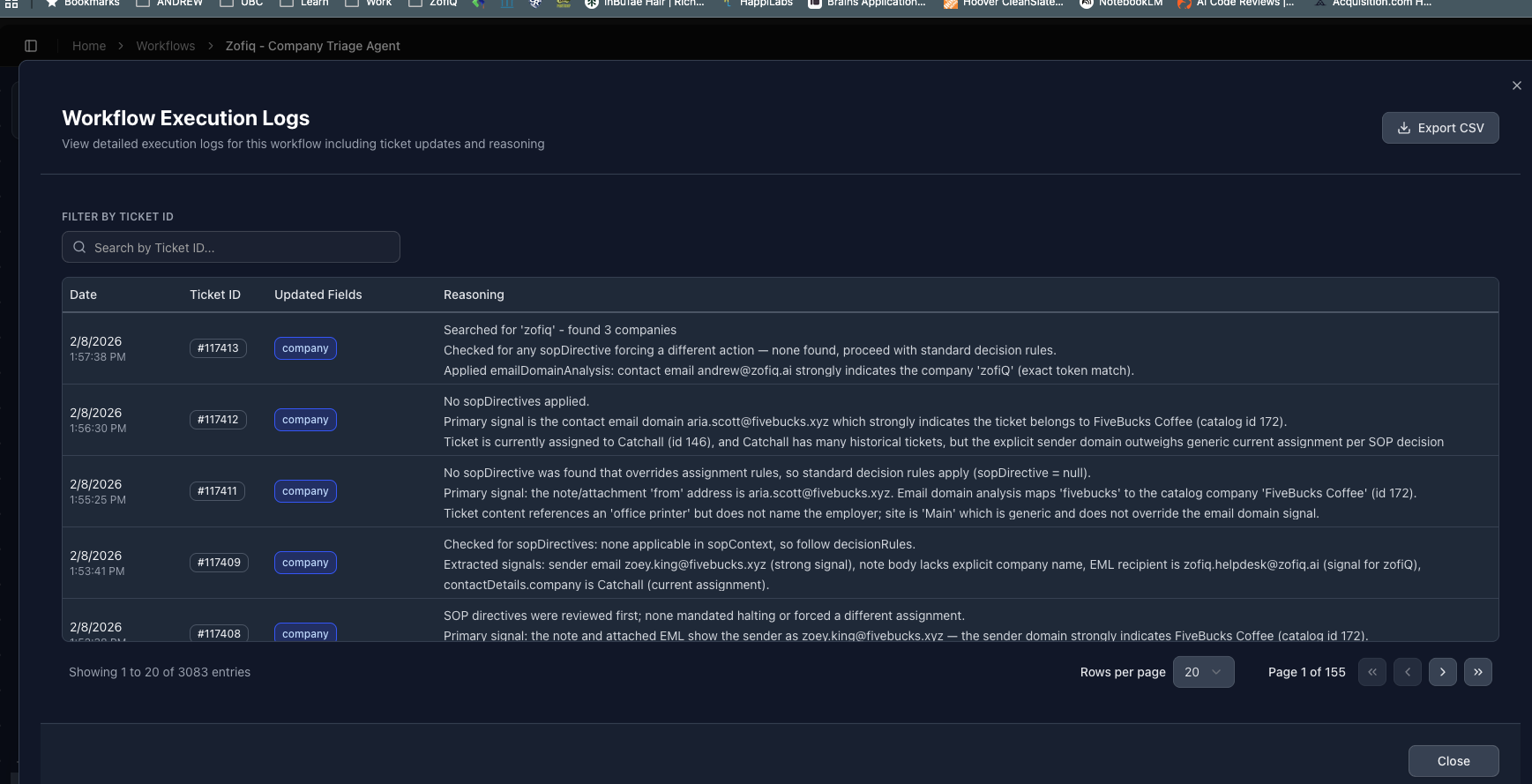
All evaluation steps, decisions, and execution outcomes are recorded in the agent’s individual Workflow Logs
Any changes applied by the agent are also reflected in the audit trail of each ticket it affects within the PSA
This provides a clear, end to end view of what the agent evaluated, what decision it made, and why, ensuring agreement assignment remains predictable, auditable, and aligned with how your organization delivers and bills for services.
If you have any other questions or concerns you can reach out to support@zofiq.ai